

Last updated: 2026-10-09
The EU Cyber Resilience Act (CRA, Regulation (EU) 2024/2847) does not spread its duties evenly across everyone involved. Whoever develops, imports or resells a product with digital elements carries a different responsibility. This page provides a technical-organisational orientation on the four economic-operator roles and compares their duties. It offers guidance, not binding individual advice; a legal assessment in the specific case remains reserved for legal counsel.
The key point up front
The substantive product-security burden sits with the manufacturer (Art. 13): it meets the essential requirements, runs vulnerability handling, draws up the technical documentation, carries out the conformity assessment, issues the EU Declaration of Conformity and affixes the CE marking. The importer (Art. 19) and distributor (Art. 20) are primarily gatekeepers: they verify that the manufacturer has met its duties and must not place or make available non-conforming products. They do not take over the manufacturer's duties.
Manufacturer (Art. 13) - the main product-security burden
The manufacturer carries the actual substantive responsibility. Its duties include:
- Meeting the essential cybersecurity requirements of Annex I Part I on the basis of a documented risk assessment.
- Vulnerability handling under Annex I Part II across the whole support period, with a software bill of materials (SBOM), security updates and a coordinated vulnerability disclosure (CVD) policy.
- Technical documentation under Annex VII.
- Conformity assessment under Art. 32: self-assessment (Module A) for products not listed in Annex III or IV; third-party assessment for Class II and critical products, and for Class I where harmonised standards, common specifications or a European scheme are not applied in full.
- EU Declaration of Conformity (Art. 28, Annex V) and affixing the CE marking (Art. 30).
- Reporting obligations under Art. 14 (actively exploited vulnerabilities and severe incidents having an impact on the security of the product) via the single reporting platform (Art. 16).
- In case of non-conformity: corrective action, withdrawal or recall.
Two figures shape the manufacturer's effort: the support period is at least five years (shorter only where the expected time of use is shorter), and technical documentation together with the EU Declaration of Conformity must be retained for at least ten years (or the support period, whichever is longer). Full details in our article on the manufacturer duties under the CRA.
Importer (Art. 19) - the gatekeeper at market entry
The importer places a non-EU manufacturer's products on the Union market. Its task is to verify conformity before placing the product on the market. Its core duties:
- Place only conforming products on the market, and specifically verify that the conformity assessment has been carried out, the technical documentation drawn up and the CE marking affixed.
- Do not place non-conforming products on the market.
- Indicate its own contact details on the product, its packaging or in the accompanying documents.
- In case of non-conformity: take corrective action.
- Inform the manufacturer of vulnerabilities and, where there is a significant cybersecurity risk, the market surveillance authorities.
On the distinction: the importer does not carry out the conformity assessment itself, does not draw up the technical documentation and does not affix the CE marking - these remain manufacturer duties. More on this on our page covering the importer duties.
Distributor (Art. 20) - due care in the supply chain
The distributor makes a product available on the market without being the manufacturer or importer. It acts with due care in relation to the requirements of the CRA (Art. 20(1)):
- Verify that the CE marking is present and that the manufacturer or importer has met their marking and information duties.
- Do not make non-conforming products available on the market.
- In case of non-conformity: make sure that corrective action is taken.
- Inform the manufacturer of vulnerabilities and, where there is a significant cybersecurity risk, the market surveillance authorities.
The distributor's verification depth is lower than the importer's - it is a plausibility and due-care check, not a re-assessment of conformity. Details in our article on the distributor duties.
Authorised representative (Art. 18) - tasks under a written mandate
A manufacturer may appoint an authorised representative in writing; in practice this matters mainly for manufacturers outside the EU. The mandate must at least allow the representative to keep the EU Declaration of Conformity and the technical documentation at the disposal of the market surveillance authorities, to provide them with the evidence on reasoned request and to cooperate with them (Art. 18(3)). Important: certain manufacturer duties cannot form part of the mandate (Art. 18(2)): design to Annex I, the risk assessment, vulnerability handling, drawing up the technical documentation and conformity in series production remain with the manufacturer.
Watch out for role changes: An importer or distributor that places a product on the market under its own name or trademark, or substantially modifies a product already placed on the market, is considered a manufacturer and is subject to the obligations of Articles 13 and 14 (Art. 21). Other persons who substantially modify a product and make it available bear these obligations for the modified part, or for the entire product if the modification affects its cybersecurity as a whole (Art. 22). An importer or distributor can therefore unintentionally become a manufacturer, for example by re-labelling or modifying. This allocation is a pitfall.
Duty-allocation matrix: who bears what?
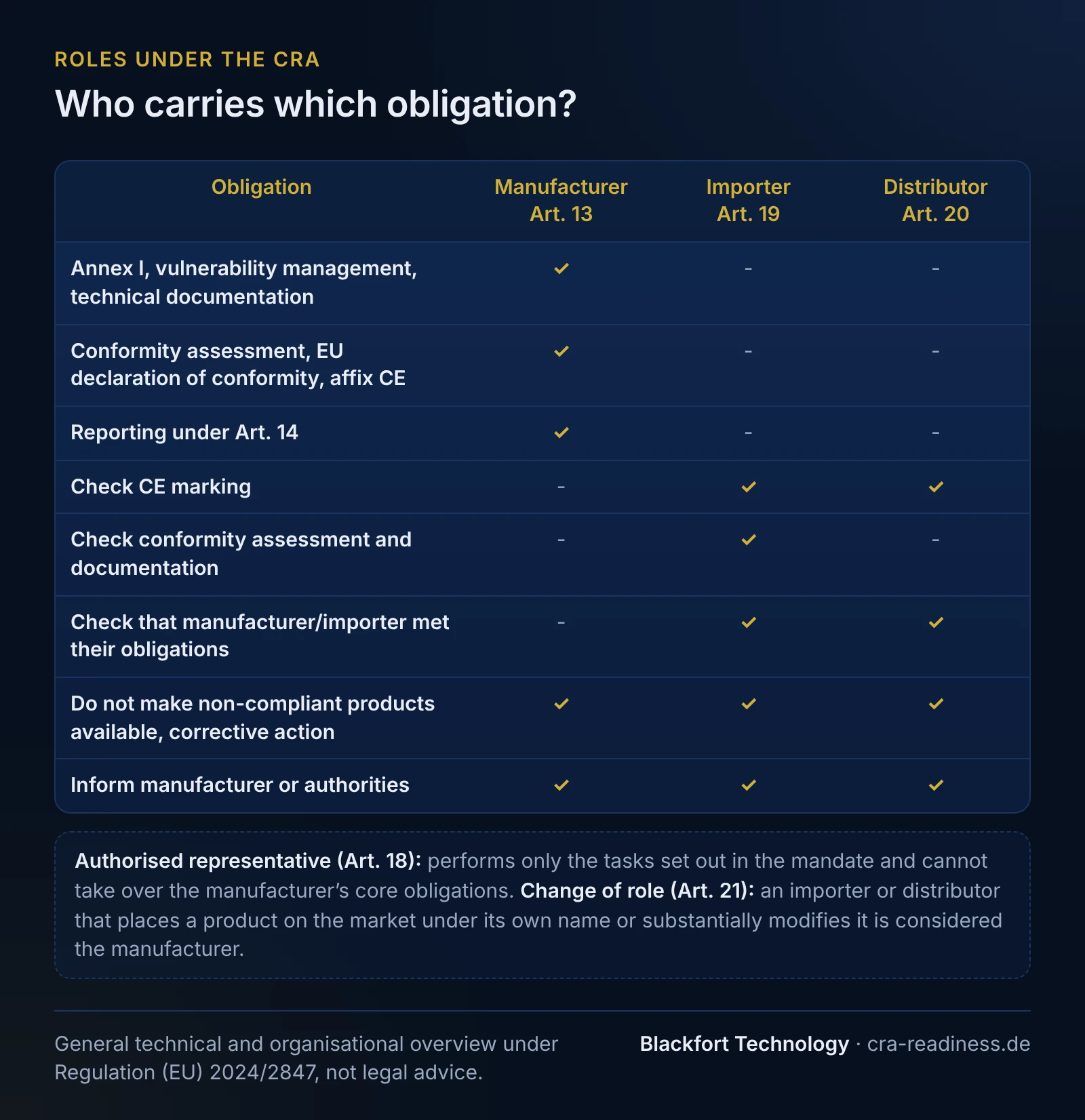
The following overview shows which role is responsible for which duty. The authorised representative (Art. 18) is deliberately not given its own column, as it performs only the tasks set out in its mandate (at least keeping the EU Declaration of Conformity and documentation available, providing information and cooperating with the authorities) and cannot take over the manufacturer duties listed in Art. 18(2).
| Duty | Manufacturer (Art. 13) | Importer (Art. 19) | Distributor (Art. 20) |
|---|---|---|---|
| Meet essential requirements (Annex I) | ✅ | - | - |
| Vulnerability handling (Annex I Part II) | ✅ | - | - |
| Draw up technical documentation (Annex VII) | ✅ | - | - |
| Carry out conformity assessment (Art. 32) | ✅ | - | - |
| Issue EU Declaration of Conformity (Art. 28) | ✅ | - | - |
| Affix CE marking (Art. 30) | ✅ | - | - |
| Report under Art. 14 (vulnerabilities/incidents) | ✅ | - | - |
| Verify CE marking is present | - | ✅ | ✅ |
| Verify conformity assessment was carried out | - | ✅ | - |
| Verify technical documentation was drawn up | - | ✅ | - |
| Verify manufacturer/importer met their duties | - | ✅ | ✅ |
| Do not place / make available non-conforming products | ✅ | ✅ | ✅ |
| Corrective action on non-conformity | ✅ | ✅ | ✅ |
| Inform manufacturer / authorities | ✅ | ✅ | ✅ |
✅ = duty of that role · - = no original duty of that role under the CRA
The practical starting point
Before allocating duties, clarify two questions: which role do I actually take on per product? and is the product in scope of the CRA at all? One and the same company can simultaneously be a manufacturer, importer and distributor for different products - duties are determined per product and role, not blanket per company. In practice this means: build a product-role register recording, for each product, the role in which you place it on the market and which of the duties shown above follow from that. This register also becomes the basis for demonstrating compliance to the market surveillance authorities. Our applicability check gives a first orientation per product.
Note: These explanations are general technical-organisational information, not legal advice within the meaning of the German Legal Services Act (RDG). The allocation of roles and the resulting duties depend on the individual case and may change with Commission guidance.
Frequently asked questions
Who bears the most duties under the CRA?+
What must an importer verify under the CRA?+
How do distributors and importers differ under the CRA?+
Can an authorised representative take over the manufacturer's duties?+
Can an importer or distributor become a manufacturer?+
Sources
This content provides general technical and organizational information on the Cyber Resilience Act (Regulation (EU) 2024/2847) and does not constitute legal advice (no legal services within the meaning of the German RDG).