

Last updated: 2026-10-09
Does the CRA apply to your business? Yes - the reporting obligation already applies.
The Cyber Resilience Act (Regulation (EU) 2024/2847) includes no size exemption for manufacturers. If you place a product with digital elements - hardware or software - on the EU market, the obligations apply to you in principle. Whether you have 10 or 10,000 employees.
Micro and small enterprises benefit from targeted relief, for example a simplified format for the technical documentation (Article 33(5)). Whether Article 64(10) exempts them from fines for a missed 24-hour early warning is, on its wording, a question of interpretation, because the provision only derogates from paragraphs 3 to 9; recital 120 points that way. The reporting obligation applies regardless of company size.
The good news: with the right starting point, the CRA can be addressed in a structured and proportionate way - if you start now.
Two deadlines that matter
| Date | What applies from then on? | Priority for SMEs |
|---|---|---|
| 11 September 2026 | Reporting obligations for actively exploited vulnerabilities and severe security incidents | Immediate - already applies, operational processes must be in place |
| 11 December 2027 | Full product requirements: security by design, SBOM, CE marking, technical documentation, EU declaration of conformity | Medium to high - allow for lead time in product development |
The first deadline, 11 September 2026, has already passed and is therefore the more urgent one. It requires working processes, not a finished product dossier. If you have no defined workflow for when a vulnerability is reported or a security incident occurs, you cannot reliably meet the reporting obligation today.
What you must have had in place operationally since September 2026
Since 11 September 2026, manufacturers have been required to report actively exploited vulnerabilities and severe security incidents via the single reporting platform, simultaneously to the CSIRT designated as coordinator and to ENISA:
- 24 hours: early warning without undue delay and in any event within 24 hours of becoming aware
- 72 hours: notification without undue delay and in any event within 72 hours, with the general information available and the corrective or mitigating measures taken
- Final report: 14 days after a corrective measure is available (actively exploited vulnerabilities); one month after the 72-hour notification (severe security incidents)
Check in advance whether these are in place: a defined point of contact for security reports, an escalation path and a template for the final report. Building these processes takes time but can be kept lean.
More on reporting timelines and channels: CRA Reporting Obligations since 11 September 2026.
Typical pitfalls for SME manufacturers
"We only make software - surely this doesn't apply to us."
Software is a product with digital elements. It falls under the CRA if its intended purpose or reasonably foreseeable use includes a direct or indirect data connection to a device or network (Article 2(1)). Purely offline software with no data connection may be out of scope; the boundary needs to be assessed case by case.
"We're too small to need a notified body."
Standard products can demonstrate conformity through self-assessment. However, this depends on the product category. Important products (Annex III, Class I and II) are subject to stricter requirements - up to and including mandatory involvement of a notified body. Which route applies to your product should be clarified early. More: CRA Product Classes: Classification and Conformity Paths.
"The SBOM obligation doesn't kick in until 2027 - that can wait."
Yes and no. The obligation applies from December 2027. Building an SBOM from the build in a commonly used machine-readable format that covers at least the top-level dependencies takes time if dependencies have never been tracked systematically. More on formats and requirements: SBOM Requirements in the CRA.
"We also sell outside the EU - the CRA only applies domestically."
The CRA is triggered by making a product available on the EU market. If you sell in the EU, it may apply if the other conditions are met - regardless of where your headquarters are located or where else you export.
Prioritised roadmap: what to tackle first when budget and time are limited
No SME needs to do everything at once. The following prioritisation is based on the deadlines and on risk.
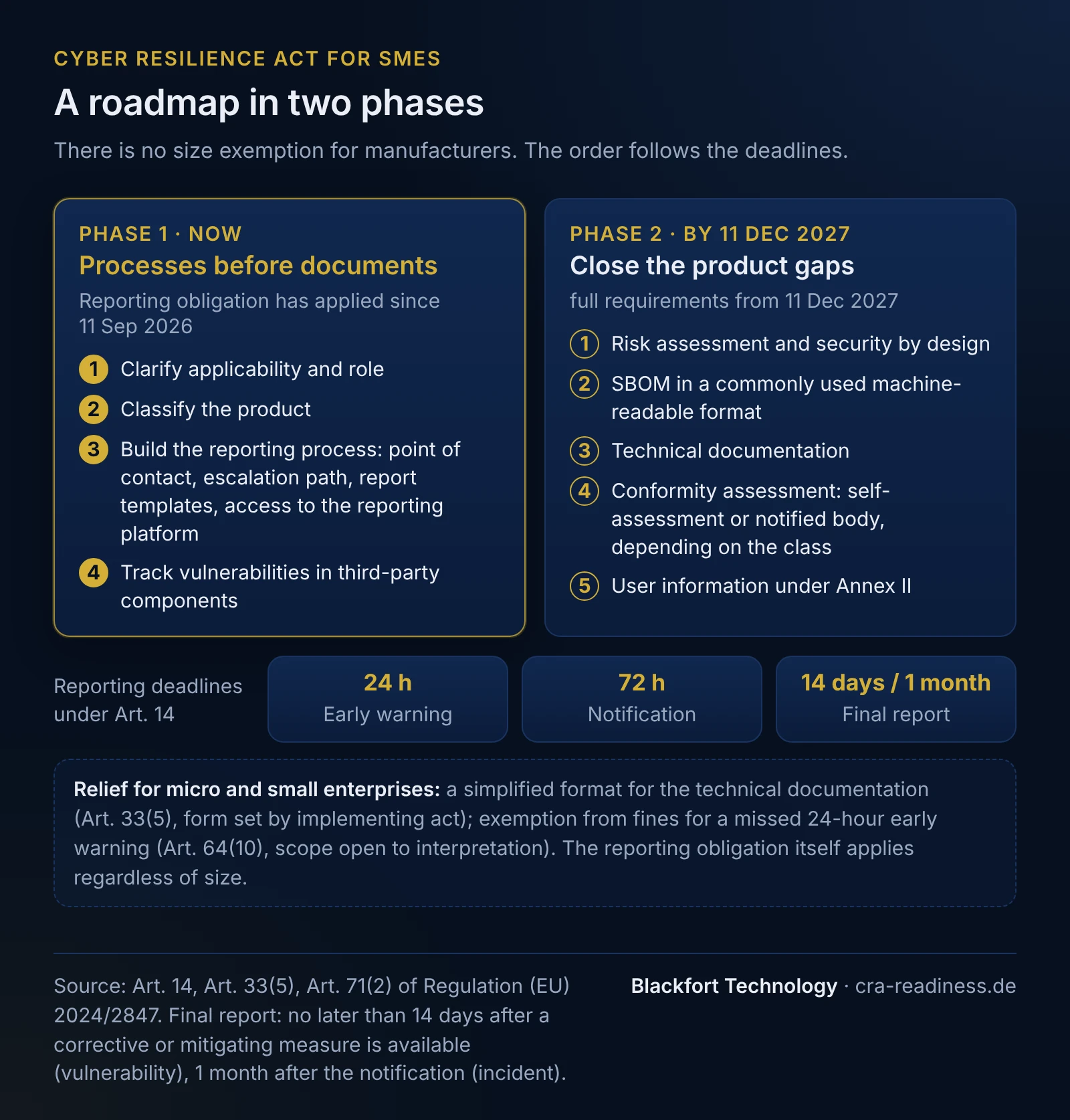
Phase 1 - Immediately: processes before documents (reporting obligation applies since September 2026)
- Clarify applicability: Does the CRA cover your product? What role do you play (manufacturer, importer, distributor)? → Interactive Applicability Check
- Classify your product: Standard, important Class I, important Class II, or critical? This determines the conformity path.
- Build the reporting process: Designate a point of contact, define the escalation path, create report templates, and prepare access to the CRA Single Reporting Platform.
- Introduce vulnerability tracking: Who reports what to whom internally? How are known vulnerabilities in third-party components monitored?
Phase 2 - By December 2027: systematically close product gaps
- Risk assessment and security by design: Cybersecurity risk assessment covering planning, design, development, production, delivery and maintenance - can be anchored in existing processes.
- Build the SBOM: Compile your software bill of materials in a commonly used machine-readable format covering at least the top-level dependencies (BSI TR-03183-2 requires CycloneDX ≥ 1.6 or SPDX ≥ 3.0.1), observe the retention obligation (at least ten years or the support period, whichever is longer). Request a gap report: have your SBOM assessed for CRA readiness
- Build technical documentation: The foundation for CE marking and the EU declaration of conformity.
- Carry out the conformity assessment: Depending on the product class, self-assessment or involvement of a notified body.
- User information (Annex II): Provide security-relevant product information to end users.
What Blackfort Technology handles for SME manufacturers
Blackfort Technology supports small and mid-size manufacturers from the initial scoping to a prepared conformity assessment, with a scope that fits the size of your company.
- Applicability and product class analysis: technical assessment of whether and to what extent your products fall under the CRA, legal questions flagged for your legal department
- Reporting process setup: Building a lean PSIRT (Product Security Incident Response) process that covers the reporting obligation in force since September 2026
- SBOM gap report: Assessing your software bill of materials against CRA requirements, tooling recommendation
- Technical documentation: Creating or reviewing the documents required for CE marking
- Conformity assessment support: Preparing for self-assessment or coordinating with a notified body
Blackfort Technology is represented in the AI security expert group of the Alliance for Cyber Security through its managing director, who is co-author of the guideline on penetration testing of large language models published there. Blackfort Technology brings its hands-on experience from PKI, DORA, NIS2, ISMS and vulnerability management projects directly into the CRA work.
Further reading for SME manufacturers
A detailed step-by-step breakdown: Cyber Resilience Act for SMEs: Prioritised Implementation Plan.
A full overview of CRA obligations: Cyber Resilience Act: Requirements, Deadlines and Obligations.
Frequently asked questions
Does the Cyber Resilience Act also apply to very small businesses with fewer than 10 employees?+
We build a SaaS product - does software without hardware fall under the CRA?+
What happens if we fail to meet the reporting obligation that has applied since September 2026?+
Do we have to build a dedicated security team to meet the reporting obligation?+
How much effort does a software bill of materials (SBOM) take for a typical SME product?+
We sell mainly in the US - do we still need to become CRA-compliant?+
Sources
This content provides general technical and organizational information on the Cyber Resilience Act (Regulation (EU) 2024/2847) and does not constitute legal advice (no legal services within the meaning of the German RDG).