
CRA SBOM consulting
CRA SBOM consulting: building your software bill of materials and vulnerability management
Together with your teams we introduce a software bill of materials per release, generated from the build pipeline, and bring vulnerability findings into one chain with clear rules for rating and remediation. The result is evidence for key requirements of Annex I Part II: the software bill of materials, vulnerability handling and disclosure.
What the CRA requires for the SBOM
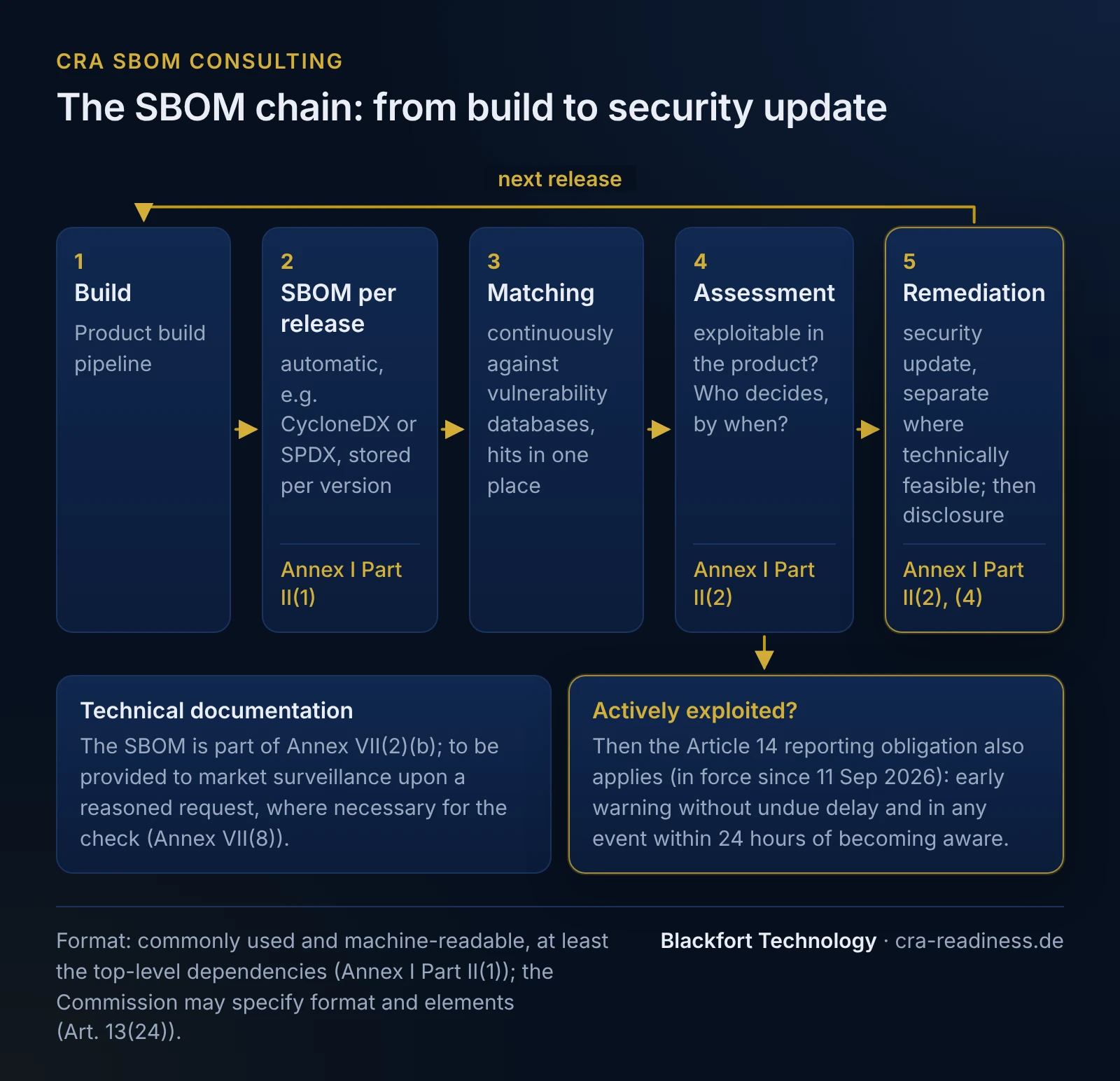
Manufacturers must identify and document components and vulnerabilities of their products, including by drawing up a software bill of materials in a commonly used machine-readable format covering at least the top-level dependencies (Annex I Part II(1)). The Regulation does not prescribe a specific format; the Commission may specify format and elements by implementing acts (Art. 13(24)).
The SBOM is part of the technical documentation (Annex VII(2)(b)). Upon a reasoned request, it must be provided to the market surveillance authority where that authority needs it to check compliance with the requirements of Annex I (Annex VII(8)). It becomes effective only through the process behind it: handle vulnerabilities without delay, provide security updates, disclose fixed vulnerabilities. Since 11 September 2026, actively exploited vulnerabilities are also subject to the Article 14 reporting obligation.
Service modules
You commission what is missing. We work with your existing tools and processes.
Inventory and selection of SBOM tools
Which scanners, SBOM tools, registries and ticket systems are in use, where they overlap, and which components and products nobody covers. We then decide the toolchain with you.
SBOM from the build pipeline
Automatic generation per release, for example in CycloneDX or SPDX, starting with one reference product, stored per version and fed into analysis.
Check your SBOM nowOne chain for findings
Continuously match components against vulnerability databases, collect hits in one place, assign ownership per product.
Rules for rating and remediation
When is a finding exploitable in the product, who decides, by when is it fixed, how are exceptions justified. Separate security updates where technically feasible.
Third-party components
Due diligence for third-party components under Article 13(5), passing SBOM information along the supply chain, reporting vulnerabilities found to the manufacturer or maintainer (Art. 13(6)).
Disclosure and CVD
Coordinated vulnerability disclosure policy, contact address and publication of fixed vulnerabilities after the update (Annex I Part II(4) to (6)).
CVD policy generatorWhat you end up with
Results that go into the technical documentation and keep running in operations.
01
SBOM per release
Generated automatically from the build, stored per version, available for market surveillance.
02
Consolidated findings chain
One view in which development sees what needs fixing, with ownership per product.
03
Target picture and operating guide
In writing, with a plan for rolling out to further products.
04
Evidence under Annex I Part II
Description of the vulnerability handling processes for Annex VII(2)(b).
How we work
From inventory to a running chain.
1
Free initial call
Products, build environment, existing tools. You then receive a proposal with a clearly defined scope.
2
Inventory
Record tools, gaps and overlaps.
3
Target picture
Agree the toolchain with you, describe rules for rating and remediation.
4
Reference product
Introduce and trial SBOM generation and matching in one pipeline.
5
Roll-out
Extend to further products as planned, hand over to operations.

Your contact
Christian Gebhardt · Founder and managing director, Blackfort Technology
Christian Gebhardt, founder and managing director of Blackfort Technology, is happy to take your enquiry personally. In a free initial call you work out together what you need; the consulting is carried out by the Blackfort Technology team.
What we do not do
So that expectations are right:
- We do not carry out penetration tests.
- No legal services: questions that need a legal decision are flagged for review by your legal department or counsel.
- You choose the tools; we recommend and set them up. Third-party licences are not included.
The CRA obligations remain with your company. We help you meet them and document the evidence.
Frequently asked questions
Which SBOM format does the CRA require?+
A commonly used machine-readable format covering at least the top-level dependencies. The Regulation does not name a specific format; the Commission may specify it by implementing acts. Examples of such formats are CycloneDX and SPDX.
Do we have to publish the SBOM?+
No. It belongs in the technical documentation and must be provided to market surveillance upon a reasoned request where needed for checking compliance. If you make it available to users, where to access it belongs in the user information (Annex II(9)).
Is an SBOM generated once enough?+
The evidence under Annex I Part II requires the ongoing process: identify components, rate and fix vulnerabilities, provide updates. That is why we generate the SBOM per release from the build.
What does SBOM consulting cost?+
The effort depends on the number of products, the build environment and the existing tools. After a free initial call you receive a proposal with a clearly defined scope.
How does this differ from the Blackfort Technology SBOM service?+
The SBOM service at https://www.blackfort-tec.de/sbom-service is an ongoing service: we generate and monitor your SBOMs and alert you to new vulnerabilities in your components. SBOM consulting sets up the chain in your own development, defines rules for rating and remediation and prepares the evidence for the CRA, so that your team runs it itself. The two can be combined.
Further reading
- SBOM requirements under the CRA
- Vulnerability handling and CVD
- CRA checklist, step 6
- Building the reporting process and PSIRT
- CRA consulting: all services
This content provides general technical and organizational information on the Cyber Resilience Act (Regulation (EU) 2024/2847) and does not constitute legal advice (no legal services within the meaning of the German RDG).
Last updated: 2026-10-09
Get in touch
Request SBOM consulting
Tell us about your products and your build environment. The initial call is free and without obligation; we usually reply within one to two working days.